Dr. Noora Fatais Al-Marri
Associate Professor at the College of Engineering, Qatar University (QU)
and the Founding Secretary-General of the Arab Association for Cyber Security
In recent years, the world has witnessed a significant shift in the way it uses and relies on cyberspace for communication and services. This shift may have accelerated due to the COVID-19 pandemic, but even after the danger of the pandemic subsided, the world continues to experience an evolution in the way we utilize the internet, which also keeps expanding in terms of what it can offer us. Today, one of the signs of a country’s progress is how much of its services are provided online and can be obtained with a click of a button. However, such ease comes with risks, such as the danger of getting hacked and the compromise of user information. This is why cybersecurity is important to protect these conveniences. Qatar has its scholars and pioneers in this field. One of them is Dr. Noora Fatais Al-Marri, a Qatari scientist with patents to her name. So, who is Dr. Noora Fatais Al-Marri?
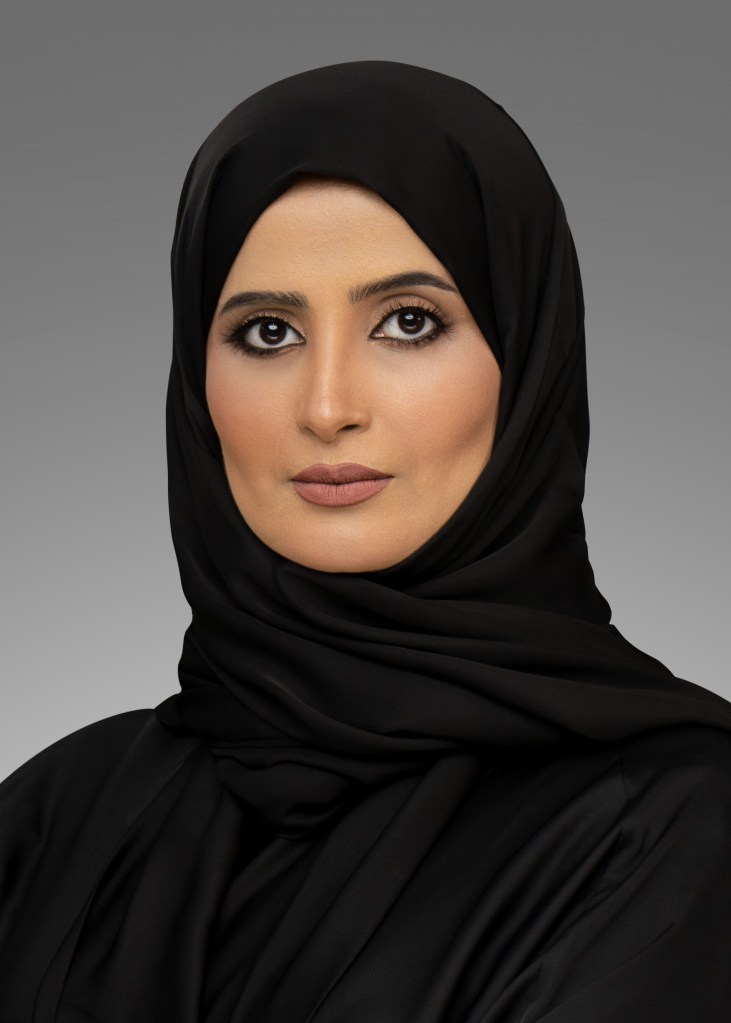
I am a researcher in the field of cybersecurity and an associate professor in the Department of Computer Science and Engineering at the College of Engineering, Qatar University (QU). I am also the founding Secretary-General of the Arab Association for Cyber Security. Additionally, I am a graduate of the first cohort of Qatar Leadership Centre and a graduate of the first cohort of Executive Master’s in Leadership from Georgetown in America. I am also a certified leader in innovation.
I was a member of the first board of directors for the Qatar UK Alumni Network and a member of the Advisory Council for Qatar Academy in Doha. I have served as a member of several national committees. I was elected as the head of the Faculty Council at QU, and to this day, I am the only woman who has held this position. After that, I took on the role of the Director of the Knowledge Intelligence, Networked Data, and Interdisciplinary (KINDI) Research Center for Computing Research.
I managed to provide security to the first virtual environment in the Middle East for simulating cyber-attacks, without any costs, and it was hosted at QU. Moreover, I contributed to the establishment of many local initiatives. For instance, I founded and organized the ‘Cyber Week’ initiative in 2017, and the ‘Raise the Flag’ competition that helped bring awareness to cybersecurity and it was organized during Qatar’s National Day celebrations. I also contributed to the establishment of the Institute of Electrical and Electronics Engineers (IEEE) Qatar Section, serving as the Vice President of the branch, where I worked to support research and scientific conferences in Qatar. Additionally, I established and organized the first local IEEE conference in Qatar in the field of cybersecurity for emerging technologies.
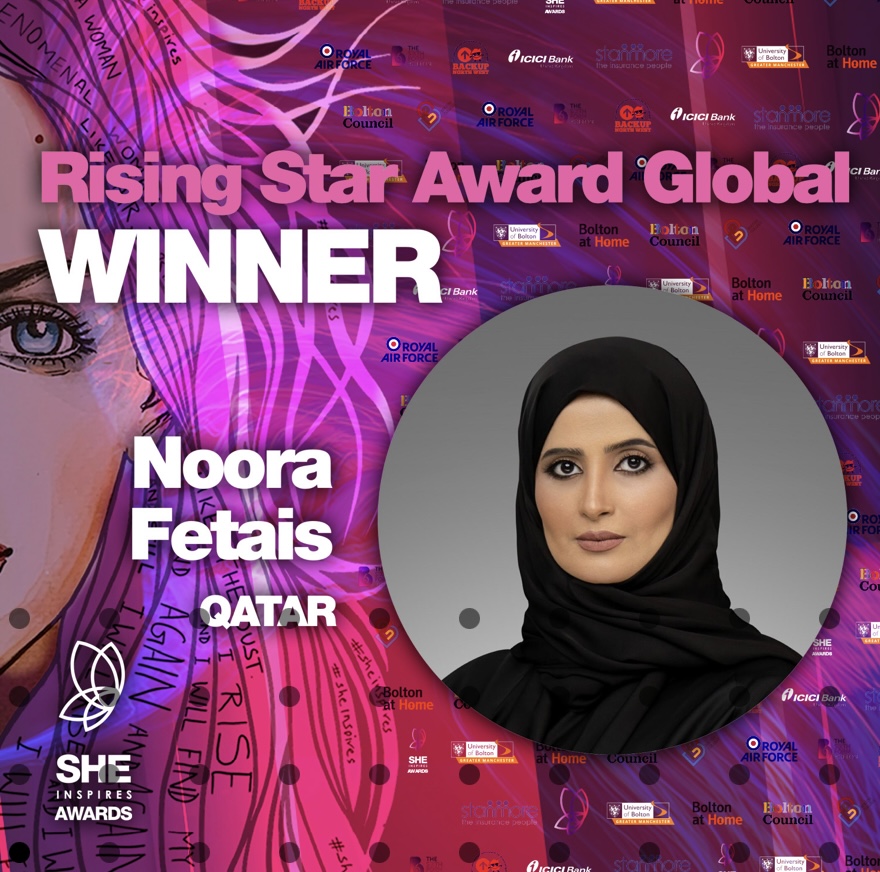
I won the Qatar University’s Award for Academic Excellence in Community Service in 2022. I also received the global ‘She Inspires’ award in 2022 in the Rising Star category, being the first person from the region to win this award. In 2019, I won the first-ever grant in NATO’s history to support women. Additionally, I have won numerous research awards.
- Can you tell us about your educational journey?
I graduated from QU after which I was recruited by them as a teaching assistant. Later, I pursued my master’s and doctoral degrees in the UK. After graduating, I returned to work at QU, initially as a lecturer, then as an assistant professor, and later promoted to associate professor. During my last year of doctoral studies, I decided to join the Qatar Leadership Centre to develop my leadership skills, as I was aiming to acquire leadership, research, and teaching skills. Years later, I enrolled in the Executive Master’s program in Leadership at Georgetown University and also obtained a certificate in Innovation Leadership from the Institute of Innovation and Knowledge Exchange in the UK. As a graduate of the University of Sussex, the university significantly supported one of my research projects and granted me a position as a supervisor to a Ph.D. student.
- What Inspired you to pursue a career in cybersecurity?
I was an outstanding student during my school days and graduated with a high grade which gave me the freedom to choose from various scientific majors to study for my bachelor’s. At that time, computer science was a new and upcoming field in Qatar, and everyone saw it as the future, so I decided to pursue it. Computer science is a vast field encompassing many specializations, and I began to focus on cybersecurity. Working in this field brings many challenges. However, I believe that challenges are what attract people to difficult fields. Challenges motivate people to strive for achievements and progression, especially if they serve their country. Cybersecurity has become a priority for nations because government services and global trade have all become cyber-based, so we need to protect our devices from hackers and protect ourselves as users because today everything is connected to the internet.
- How would you describe your journey in this new field?
My journey is still ongoing, and technology continues to evolve daily which is impacting and shaping cybersecurity. What is great about that is that every day brings something new, keeping me on my toes. I love new things and thrive on challenges. I work with researchers from various countries like Korea, Australia, America, France, the United Kingdom, and Italy. These research projects are funded either by the Qatar National Research Fund for Development and Innovation (QNRF), by QU, or through collaboration between QU and international universities.
- Tell us about the different roles you undertake under the umbrella of cybersecurity.
I perform and engage in various activities related to computer science and cybersecurity. As a faculty member at QU, my work includes teaching various related subjects and participating in research with other institutions both within and outside Qatar. I also supervise research projects for undergraduate, master’s, and doctoral students. I focus on highlighting and unleashing the capabilities of students, researchers, and my team to build national capacities.
I believe in cyber diplomacy and the importance of Qatar having a strong presence in the global cybersecurity arena. I discussed effective cyber diplomacy at the Milipol Qatar exhibition in 2022. I also spoke about it in 2022 during the event: ‘Cyber Diplomacy and Governance: Opportunities, Challenges, and Ways Forward in the Arab States’ for the Royal Institute of International Affairs (Chatham House) in Jordan.
In addition to my local achievements, I have accomplishments on a regional and global scale. For example, since 2021 I have been the founding Secretary-General of the Arab Association for Cyber Security, an association affiliated with the Union of Federation of Arab Scientific Research Councils (FASRC), which was established by a decision of the Arab League. As the founding Secretary-General of the Association, I launched the first student branch of the Association at QU. There are plans to open student branches in all Arab countries. There will also be competition between these student branches. My role as a Qatari is to build national capacities, and my role in the Association is to build national and Arab capacity.
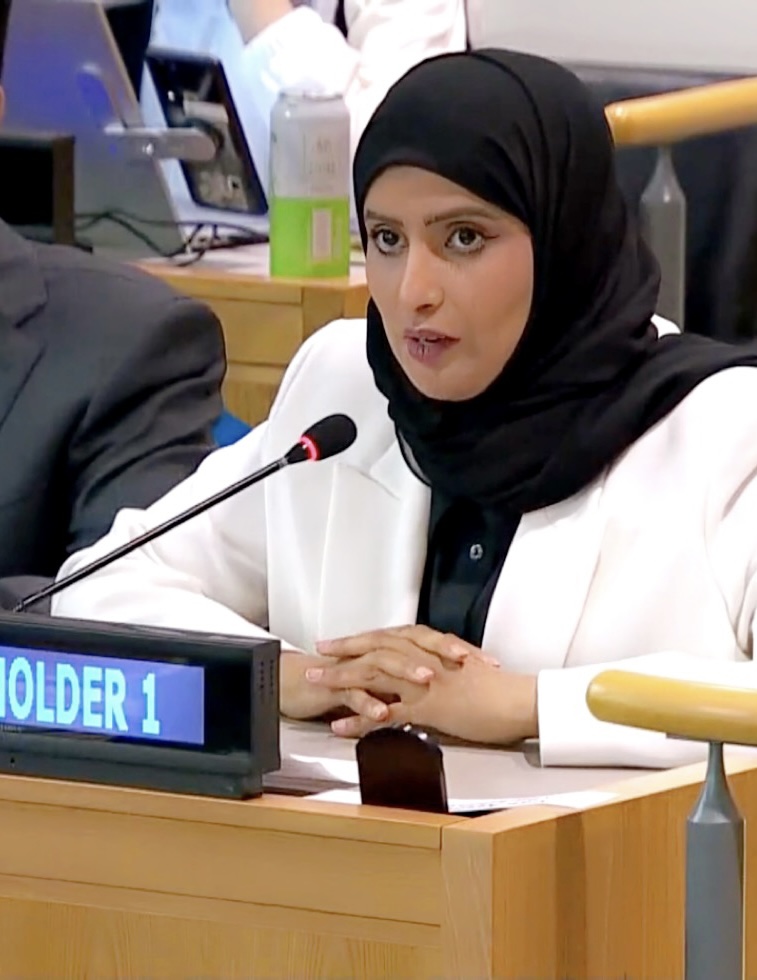
In 2023, the United Nations officially recognized the association I established as the first and only Arab non-governmental organization in this field, and I participated as a speaker. The Association has so far succeeded in signing several important agreements and projects with very important global entities, such as the Organization of Islamic Cooperation and the United Nations’ Arab Regional Cyber Security Center. I also chair the Qatari branch of the ‘Middle East Women in Cybersecurity Network’, which provides training and support for women in cybersecurity, empowering them with guidance, support, and feedback, and helping them develop their skills in cybersecurity.
On a global scale, I have received a fellowship from the Institute of Innovation and Knowledge Exchange in the United Kingdom and represent QU at the International Telecommunication Union in the United Nations. I won the first-ever NATO grant in support of my initiative: ‘Women in Cyber,’ aimed at supporting women in cybersecurity fields. This conference was held in Qatar in 2019. I was selected in the first cohort for the UK-Gulf Women in Cybersecurity Fellowship and have been consulted in all subsequent cohorts. I am also an expert in many global and regional institutions and a high-level member of numerous societies, academies, and scientific and research institutions. I deliver lectures and participate in forums and seminars at many international venues, such as the Royal Institute of International Affairs, in addition to doing research related to cybersecurity.
Furthermore, I am a mentor for women in cybersecurity under the umbrella of the International Telecommunication Union, which in turn is under the United Nations, as part of a mentoring program named ‘Women in Cybersecurity – A Mentoring Program for 2022.’ Through the program, I act as a mentor for three women from different nationalities in a highly competitive mentoring program.
- What are some of the research projects that you have worked on?
My research follows two different paths: a cybersecurity path and a community path. One of the community projects I am working on is a project on preserving heritage in the era of technology, which aims to educate about our heritage through games in the virtual world and to encourage researchers to utilize technology for this purpose. I worked on the falconry project (Al-Maqnas), and as new technologies were developed, we used them on the platform. For example, the platform used Virtual Reality (VR), Augmented Reality (AR), and Mixed Reality (MR) technologies to serve its goals. We presented this platform at the 2021 Suhail Exhibition (Katara International Hunting and Falcons Exhibition). I am currently working on the Virtual Museum project and a platform for training athletes in the virtual world, starting with goalkeepers.
In the cybersecurity path, I am working on cybersecurity projects and the visual representation of its policies. Recently, we worked on a cybersecurity project in the maritime field. These efforts resulted in two patents that were registered in the United States for me and my team, and we are in the process of registering a third one. I have also been a member of the committee responsible for writing the national framework for blockchain technology, which was recently launched by the Communications Regulatory Authority. New technologies are still emerging, and our role is to adapt them to serve us.
- Which one of your projects is the closest to your heart?
All my projects are close to my heart because each of my projects is a part of myself. My projects may pause for some time, either due to a lack of funds or the need for more advanced technology, but they never die. Even if they had to stop, they could be the starting point for a bigger project. However, among the projects that I am proud of are my projects in the field of cybersecurity and its policies, and my projects in the field of virtual reality.

- Have you faced any challenges during your journey?
Allah has blessed me with a supportive family, and I have full support from my father and mother. Without their constant support, I wouldn’t have overcome many difficulties, and I would not have accomplished anything. I might have even stopped at the first difficulty I encountered. Difficulties are necessary; without them, we have no achievements. How we deal with these difficulties varies from person to person, and that’s what makes us different. However, getting support is essential, especially support from people in your field of expertise. Scientific networks and associations are a strong source of support, which is why I made sure to establish associations related to cybersecurity here in Qatar.
- What is your advice for women in Qatar?
Believe in yourself and continue to develop your skills. Join international associations to benefit from their experts and stay away from negative people. My advice to everyone is to develop their technological skills and to continuously read about cyberculture.

Related Interviews


Fatema Ahmad
published 24/01/2024
- All Pictures were provided to us by the interviewee, unless stated otherwise.
- Interview was edited to improve clarity and readability.