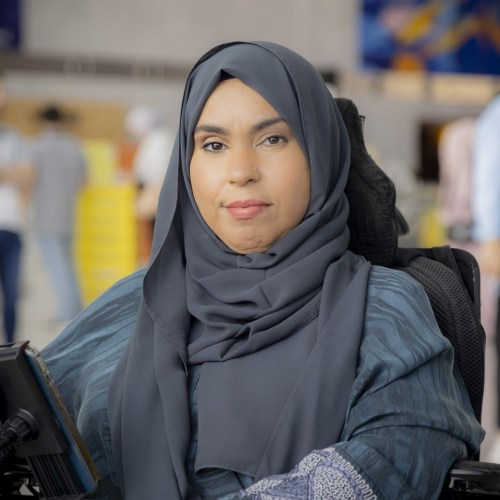
In this interview, Dr. Noora Ahmed Al Thani, a Qatari doctor, shares with us her professional and personal journey as a wife and mother. So, who is Dr. Noora Ahmed Al Thani?
Noora is a wife and a mother to Abdullah and Ahmed. I graduated in 2012 from medical school and currently work at Hamad General Hospital as an endocrinologist specializing in diabetes and thyroid cancer.
Have you always wanted to be a doctor?
Initially, I didn’t aspire to study medicine, but I remember when I was in kindergarten there was a teacher who constantly told me I would become a doctor one day because I was an excellent student. She repeated this even after I entered primary school, and I think she planted the first seed in my head to become a doctor. Another aspect that encouraged me to pursue medicine is my uncle, Sheikh Dr. Hassan bin Ali Al Thani, who studied medicine in Ireland. I remember that when he visited us when he was still a medical student, his son showed us his father’s stethoscope, which intrigued me and sparked my curiosity about the field. Moreover, I wanted to help my father, who frequently needed medical attention, and I thought I could help him myself if I became a doctor. Medicine is a vast field with many specializations. Unfortunately, Qatar has a shortage of Qatari doctors in all those fields. This aspect played an important role when I had to decide what field of medicine, I would specialize in. During our training rotation, we worked in various departments, including pediatrics, which I loved. I also worked in the surgical department, which I enjoyed because it directly helps patients. However, some aspects of surgery did not appeal to me, so I didn’t choose it despite liking the field. I wasn’t very interested in obstetrics and gynecology, even though it involved witnessing the miracle of life and helping patients. In the end, I decided to choose internal medicine, because I will be able to treat many diseases, including cardiology, pulmonology, and diabetes. Ultimately, I specialized in diabetes because it is widespread in Qatar.
How was your journey studying medicine?
During high school, I knew I would study medicine, which meant I would have to travel abroad. Although I hadn’t decided on a university and a location, I was greatly influenced by my uncle’s choice. Thankfully, it turned out that a branch of the same university he studied at in Ireland opened in Bahrain, so I enrolled there. Since Bahrain is close to Doha, I didn’t feel estranged. My mother even lived with me there for a while, and it was easy to visit my family. However, living abroad for the first time had its challenges, but I eventually adapted and learned many things. Alongside learning medicine, I learned how to rely on myself, how to express my feelings, how to show gratitude, and how to love those who deserve it.
Studying medicine was indeed challenging, but I enjoyed it. I marveled at Allah’s wisdom and miracles in creating the human body. No matter how difficult the journey became, I never seriously considered quitting because I grew up knowing that medicine was the field I wanted to pursue.
Can you describe a typical working day as an endocrinologist?
Typically, our day starts with educational activities for trainees or resident doctors. Then, I began my work by seeing the visiting patients who came with appointments, followed by rounds on inpatients in the hospital.
How does being a woman shape your experience as a doctor?
In my opinion, the two most important things that one needs to succeed in this field are time management and mutual understanding between partners. When I was a resident doctor, I worked shifts and had exams, and I wasn’t married, so I had fewer commitments. My parents were very understanding and supportive of my work. Thankfully, I married a man who understands the nature of my job. Also, I knew I wanted to get married and have a family, so I considered these things when choosing a specialization. I wanted to have a work schedule that would allow me to be present for my family. This doesn’t mean women can’t specialize in these fields; it was just my personal preference. Many things become easier with the understanding and the support of society, family, and good time management.
Have you faced any challenges during your journey?
I remember one challenging moment. During my work in the intensive care unit, I saw a lot of difficult medical cases. On my first day, I was busy at the end of my shift writing notes about each patient when I was told about a dialysis patient whose condition deteriorated during dialysis, and his heart stopped. We began resuscitation, and this was the first time I faced such a situation. Although we were trained for it, this was a real-life scenario. The attending doctor discussed with the patient’s family that it might be better to let him go because he had many health problems. The patient’s son was in the room and couldn’t say a word, but he held the hand of the person performing the resuscitation and stopped him. This moment is etched in my memory.
However, my job also has joyful moments. For example, when patients pray for me, and I thank Allah for guiding me to help them. One funny moment that I remember was with an elderly female patient. I had to gather her health data and daily habits. She had a heart disease, and one of the questions that I had to ask was about smoking. I asked her all the questions except that one because I didn’t expect her to be a smoker. When I explained this to the attending doctor, he took me back to her and asked if she smoked, to which she replied, “Yes, for a long time!” To my surprise!
Could you tell us about your achievements?
One of my achievements is the look of pride in my parents’ eyes, especially my father’s, who calls me: “my doctor.” I also consider being a mother to be my greatest achievement. I always think about how I am raising my children and believe that, as a mother, what I teach them in terms of religion and good behaviors and practices will earn me rewards. Professionally and academically, I am still on the journey and aspire to learn more and participate in research to combat diabetes in Qatar.
What is your advice for women in Qatar?
There are no limits to your ambitions. You can be a working woman, a wife, and a mother, and excel in all these roles. Being a mother and raising the next generation does not diminish your value; it is a gift from Allah. Remember that every delay in life is a blessing, and things will work out even after a while and that all Qatari women are capable.